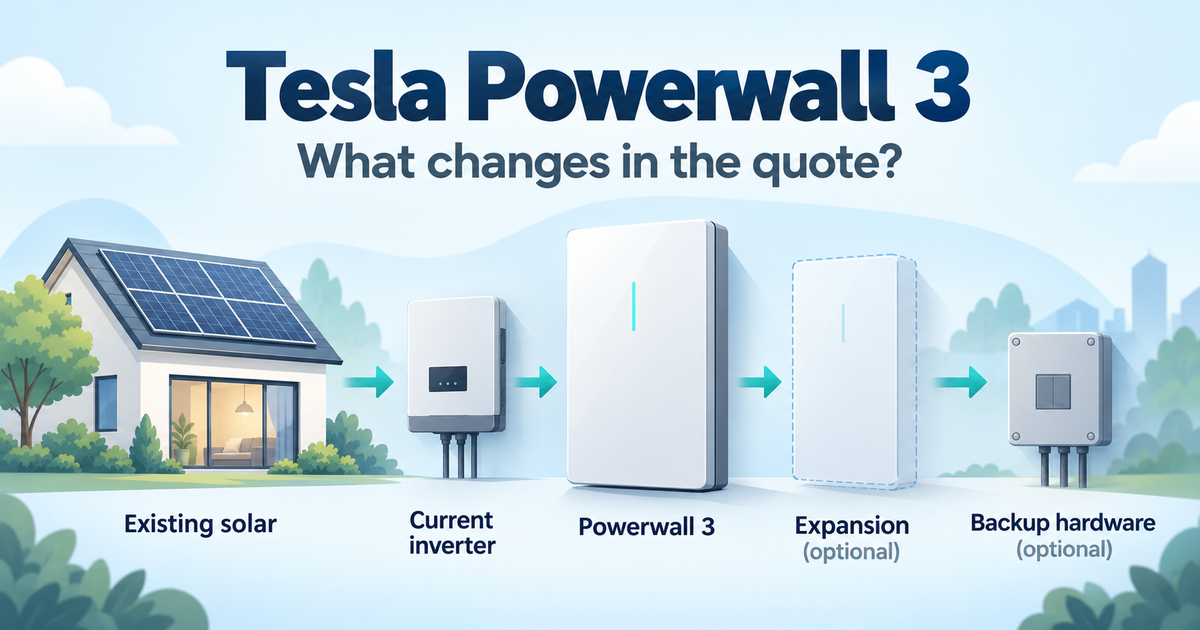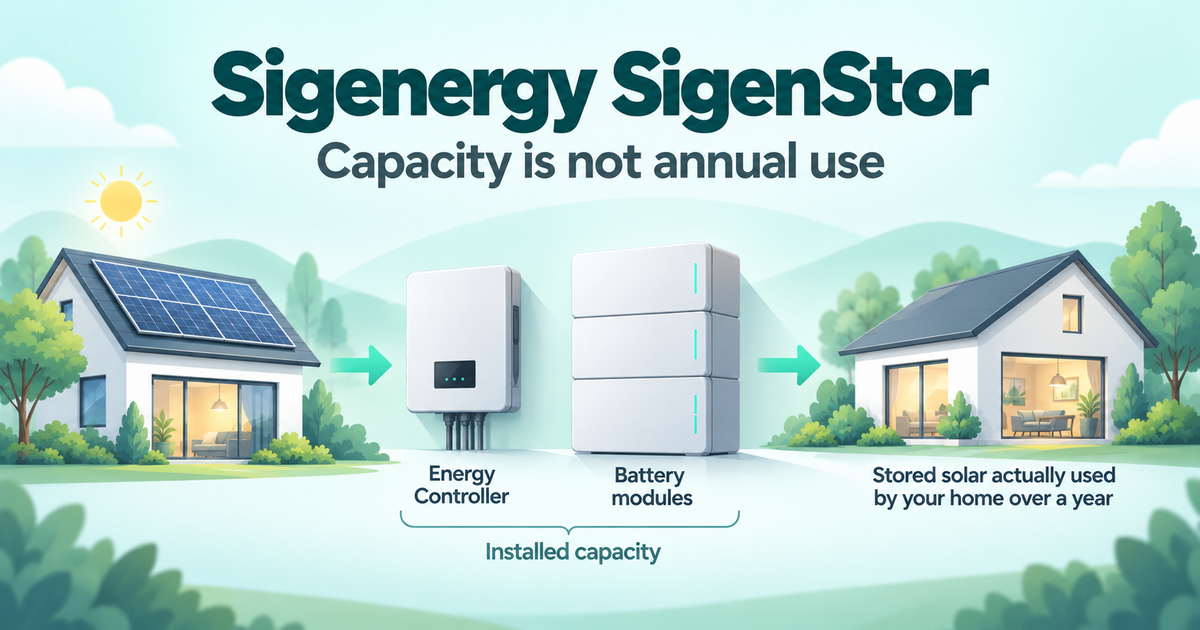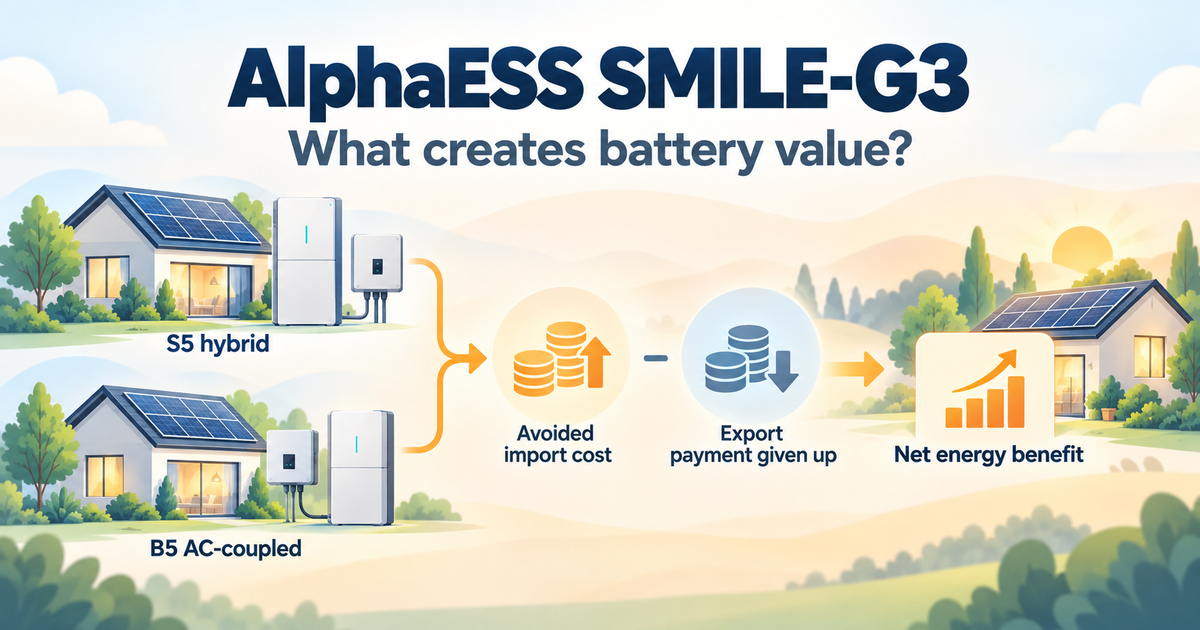
HOME BATTERY DECISION SUPPORT

Is a home battery worth the extra cost?

Compare the additional cost of a battery for an existing solar system across three usage scenarios using your own prices and assumptions.

  • No sign-up
  • Inputs stay on this page
  • Transparent assumptions

How it works

  1. 1Enter your quote
  2. 2Set operating assumptions
  3. 3Compare three usage scenarios

JavaScript is required. The calculator stays disabled until it has loaded successfully.

Battery payback calculator

Your own inputs

Build your estimate

Before you begin: this calculator assesses adding a battery to an existing solar system. Enter your quote, prices and three explicit assumptions for first-year AC energy delivered from the battery to your home from solar that would otherwise be exported. Use your own what-if values or a comparable documented estimate. Price and capacity alone do not determine this energy. The example is for learning; the calculator does not create or validate a personal forecast.

All money inputs must use one currency and the same tax basis for you. No taxes or subsidies are inferred.

1 Costs and prices

Use a decimal point. Do not enter thousands separators, units or unfinished decimals.

Select the currency used for every money input. Changing it updates labels only; amounts are not converted.

Include the battery, additional inverter, installation, commissioning, taxes you pay and other mandatory upfront costs. Exclude the existing solar system; the comparison is against the same home and existing solar system without a battery.

Enter only the per-kWh charges avoided when you buy less electricity. Exclude unchanged fixed charges.

Enter the net export income forgone for each charging kWh.

Include recurring battery costs such as maintenance, subscriptions or separately estimated idle consumption. Do not count losses already included in whole-system AC efficiency again.

2 Operating and time assumptions

Use a decimal point. Do not enter thousands separators, units or unfinished decimals.

Enter percentage values as displayed: 90 means 90%; 0.9 means 0.9%.

Use whole-system AC efficiency, including charging, discharge, wiring and allocated auxiliary losses. Enter 90 for 90%; entering 0.9 means 0.9%. The boundary is energy delivered to the home divided by solar energy that would otherwise be exported. Cell-only DC efficiency is not suitable.

Your assumed annual decline in delivered energy, not a prediction of cell condition.

Years included in the financial analysis. This period cannot exceed your separately assumed battery operating life.

Your assumed operating-life limit, separate from warranty. A longer life does not add cash flows beyond the analysis period.

A real annual return target using prices in today’s purchasing power.

3 Usage scenarios

Use a decimal point. Do not enter thousands separators, units or unfinished decimals.

Annual battery use means first-year AC energy delivered from the battery to your home, replacing grid purchases, from solar that would otherwise be exported. It is a scenario assumption, not a forecast. Do not subtract efficiency losses again.

Choose three explicit what-if amounts, or use an external estimate whose meaning matches this boundary. Your own what-if values do not need a source document. Equal values are allowed; other assumptions are shared.

Central is your chosen middle amount, not an expected value or a required midpoint. Lower and Higher describe energy, not better financial outcomes. Capacity, annual consumption and solar generation do not establish when charging and discharge are possible.

Reading an external energy estimate

Check that the figure covers the first operating year, uses the same home and solar system without a battery as the comparison, and counts only AC energy delivered to the home that replaces grid purchases from solar that would otherwise be exported. Check how losses and the efficiency boundary are defined, and exclude grid charging, battery exports and other uses outside this comparison.

Capacity, charging energy, DC discharge, total solar generation, total consumption, self-consumption percentages and whole solar-plus-battery savings are not this figure. An existing battery’s measured year may also reflect a different age or operating setup and does not by itself establish the no-battery comparison.

If the meaning is unclear, ask the source for the matching figure and its assumptions. Do not guess an efficiency conversion. Price and capacity alone are not enough. You can still choose your own conditional what-if amounts; the illustrative example is only for learning.

One external figure does not determine three scenarios: you may use equal values or choose other amounts explicitly. A documented estimate is a possible source, not a forecast validated by this calculator.

First-year AC energy delivered from the battery to the home.

First-year AC energy delivered from the battery to the home.

First-year AC energy delivered from the battery to the home.

Optional information: Warranty period: Unknown; Solar surplus exported without a battery: Unknown; Grid electricity imported without a battery: Unknown; Usable battery capacity: Unknown; Nominal battery capacity: Unknown.

Optional checks and quote details

Known uses the value you enter; Unknown leaves it out. Unknown is not a passed check. Invalid Known values block all results. Timing, power and state of charge are not checked.

Warranty period
Solar surplus exported without a battery
Grid electricity imported without a battery
Usable battery capacity
Nominal battery capacity

YOUR CURRENT ESTIMATE

Scenario results

These scenarios are decision-support estimates, not a confidence interval or a purchase recommendation.

Enter your assumptions and calculate to see results.

Start with your own assumptions

Enter your quote and three usage amounts, then select Calculate scenarios. No financial defaults have been chosen for you.

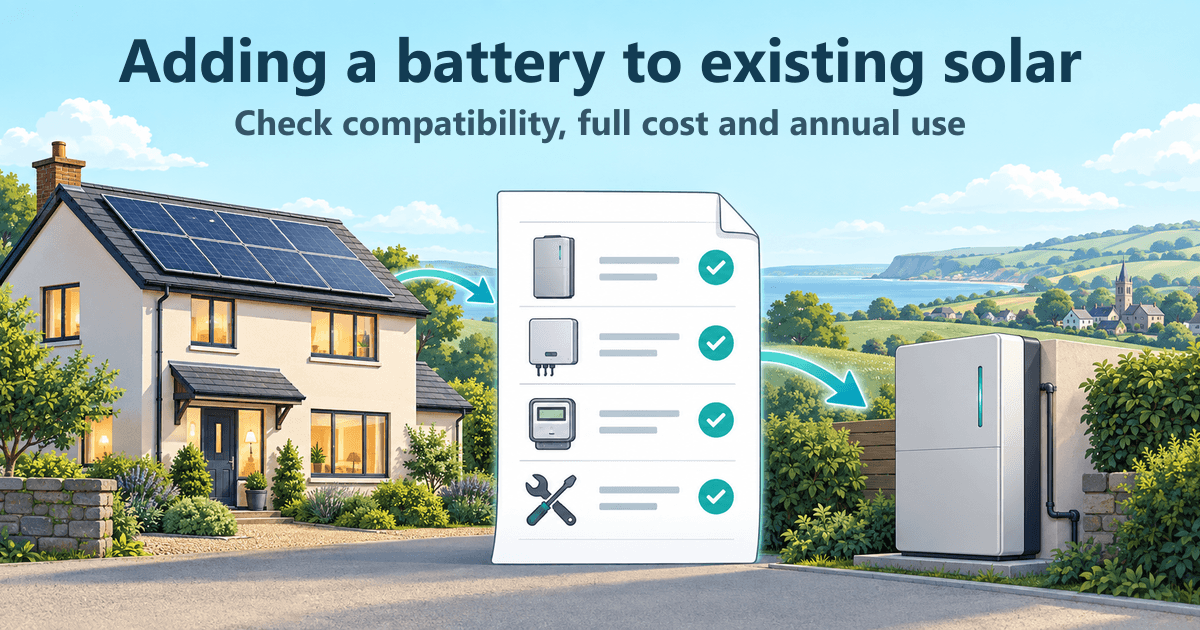
Next step: check an itemised quote

If you have a quote, compare its full installed cost and annual-use assumptions with any scenario you choose to calculate. If you do not, ask an installer to itemise the required equipment and work. A calculation alone is not a buying recommendation.

Use the quote checklist How the calculations work

What this model leaves to you

Included in this estimate

  • Additional battery upfront cost
  • Avoided electricity purchase cost and forgone export income
  • Additional annual costs and whole-system AC efficiency
  • Annual decline in delivered energy
  • Three user-provided usage scenarios
  • Analysis period, operating life and real annual return target

Not included

  • Hourly tariffs, grid charging or reserve and grid-service revenue
  • Loans, financing, automatic subsidies or taxes
  • Backup-power value, replacement battery, residual value or a separate end-of-life cost
  • Timing feasibility, power limits or state-of-charge feasibility
  • An automatic forecast of actual annual output or usage

Prices and annual costs stay constant in today’s purchasing power. Usage is a scenario, not a forecast. Actual ageing, operating life and warranty conditions need separate checks. Include mandatory upfront costs in the quote and ongoing additional costs in the annual cost input.

A known mandatory replacement or material end cost does not fit this model. Unaccounted losses are not assumed covered.

Battery Payback is a decision-support estimate, not a savings, payback or return promise.

Inputs stay in this page’s memory. They are not sent, logged or stored. Reloading starts with an empty calculator.

Battery buying guides

Start with the general UK guide, then use the product guides to understand configuration-specific questions before entering your own figures.
Decision guides: Are solar batteries worth it in the UK? · Home battery cost in the UK · What size home battery do I need? · Compare Powerwall 3, SigenStor and SMILE-G3

More product-specific checks: Enphase IQ Battery 5P existing-solar and quote guide and GivEnergy All in One warranty, support and quote guide.

Browse all UK battery guides · All guide markets