
UK HOME BATTERY COMPARISON
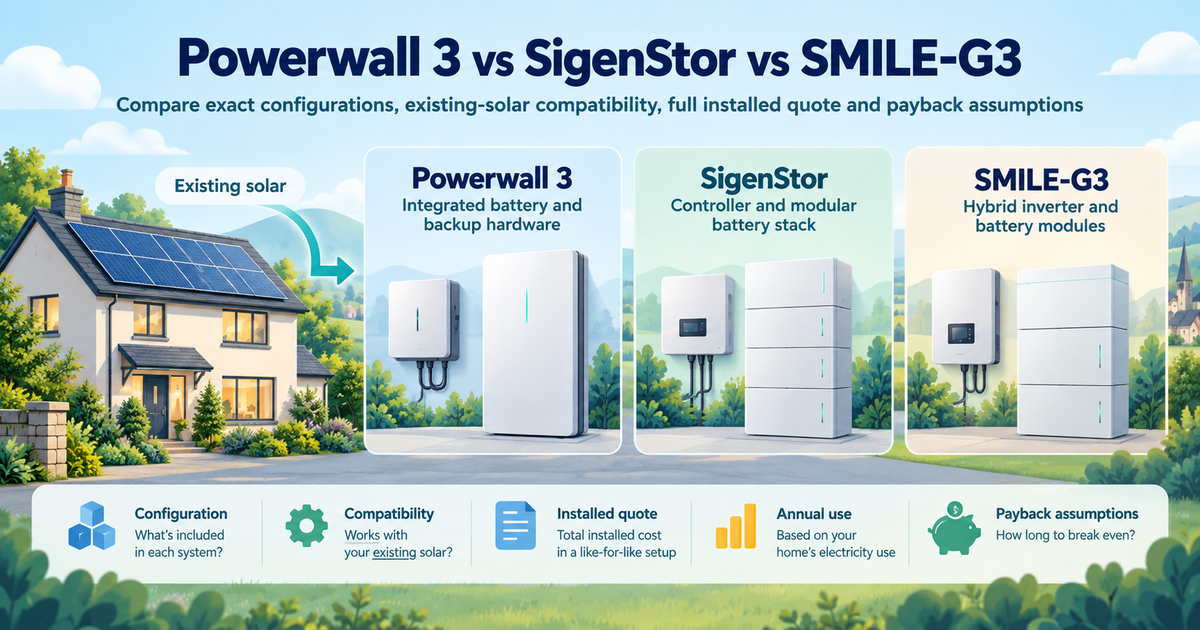
Tesla Powerwall 3 vs Sigenergy SigenStor vs AlphaESS SMILE-G3
Adding a battery to existing UK solar? Compare Tesla Powerwall 3, Sigenergy SigenStor and AlphaESS SMILE-G3 by exact configuration, retained equipment, total installed cost and your use assumptions. This covers only those three families—not the whole market—and neither ranks products nor approves a design.
Based on manufacturer documents and illustrative calculations, not a hands-on product test.
Compare your quote assumptions
Read the existing-solar battery guide.
What this comparison covers
Compare only the extra battery investment, not the existing solar installation's sunk cost. Model, modules, inverter route, phase, metering, gateway and backup scope must be specified; manufacturer documents do not replace a site-specific assessment.
The calculator excludes joint new solar-and-battery purchases, grid charging, dynamic tariff optimisation, backup value and reserve or grid-service revenue. Those benefits may matter but need separate assessment, as do electrical and safety design.
Powerwall 3 vs SigenStor vs SMILE-G3
The figures below retain each source's measurement boundary. Battery energy is not annual AC delivery to your home. Nominal and usable energy, continuous and peak power, and AC and DC ratings must not be interchanged. Ask the installer to identify the exact revision and components on your quote.
| Comparison point | Tesla Powerwall 3 | Sigenergy SigenStor | AlphaESS SMILE-G3 |
|---|---|---|---|
| Configuration reviewed | One Powerwall 3, UK datasheet model 1707000-xx-y; Expansion and Backup Gateway 2 are separate components. | Sigen Energy Controller with BAT 8.0 module; controller phase and module count must be specified. | Single-phase S5 hybrid or B5 AC-coupled inverter with the named BAT module; the older V08 sheet's BAT-8.2P is one example. |
| Existing-solar connection to confirm | Integrated solar inverter; ask whether the existing inverter remains and how AC or DC solar is connected. | Controller-based system; confirm the exact single- or three-phase controller, existing inverter and metering route. | S5 is hybrid; B5 is AC-coupled. Confirm whether the existing solar inverter remains. |
| Published battery capacity | 13.5 kWh usable AC for one Powerwall 3 under datasheet test conditions; not nominal cell capacity. | BAT 8.0: 8.06 kWh total and 7.8 kWh usable per module under module-sheet conditions; system total depends on module count. | V08 BAT-8.2P: 8.2 kWh module capacity and 7.8 kWh usable under stated conditions. Other G3 modules differ; confirm the quoted revision. |
| Published continuous output | Single-phase nominal AC output selectable from 3.68 to 11.04 kW in the UK sheet; confirm the configured rating. | Configuration-dependent. The BAT 8.0 sheet gives 4 kW maximum charge/discharge per module, not the controller's continuous AC output; confirm both limits. | S5/B5: 5 kW nominal single-phase AC output in V08; confirm the precise inverter and battery limit. This is not a peak figure. |
| Backup or gateway arrangement | Backup Gateway 2 is required for the documented backup configuration; Powerwall 3 can also be installed without backup. | Confirm whether a Sigen gateway and backup equipment are in the proposed system and which loads are covered. | Confirm metering and the proposed backup arrangement and loads for the exact S5 or B5 installation. |
| Warranty evidence reviewed | Tesla European Warranty Region, revision 1.16, 3 December 2025: check the 10-year terms and internet condition. | Sigenergy Europe warranty, 27 May 2025: 10-year product term and battery retention/throughput test; UK applicability must be confirmed in writing. | AlphaESS UK G3 warranty, December 2024: UK approved-installer scope, 10-year product and performance terms, DC-side capacity test. Clarify its conflicting retention wording. |
| Quote items that can change the cost | Existing-inverter plan, Powerwall count, Expansion, Gateway, metering and electrical work. | Controller model, phase, BAT models and count, metering, gateway and backup scope. | S5 or B5 inverter, exact BAT models and count, metering, backup equipment and any inverter replacement. |
| Detailed Battery Payback guide | Read the Tesla Powerwall 3 guide | Read the Sigenergy SigenStor guide | Read the AlphaESS SMILE-G3 guide |
The SigenStor module power figure is a battery-side DC limit, not system AC output. AlphaESS's reviewed V08 sheet and later V2.3 brochure cover different module generations; do not combine their values.
Which battery fits an existing solar system?
Ask whether your inverter stays, is replaced or needs an additional battery inverter or controller. Confirm metering, mandatory gateway equipment, backup loads, AC/DC and phase ratings, and installation locations. There is no configuration-independent winner.
The installer must assess property eligibility, electrical design, product suitability, safety, permissions, notifications, compliance, installation and commissioning. Battery Payback cannot approve an installation.
What changes the installed cost?
Compare the whole incremental cost of adding storage, including the battery unit and exact modules; inverter or controller; gateway, backup and measurement equipment; keeping, removing or replacing existing hardware; mandatory electrical work; installation and commissioning. All mandatory costs at installation belong in the additional installed cost. Ask what the offer excludes and price optional upgrades separately.
Request ongoing monitoring, subscription and service charges and any known later replacement or end costs. The calculator's additional annual costs input represents a real, constant yearly incremental expense. It does not model a later one-off battery replacement or separate end costs. If a mandatory replacement or material end cost is known, make a broader comparison before deciding. Read the installed-cost guidance for existing solar.
Which option has the strongest payback?
There is no product-level payback winner without a like-for-like installed quote and the same household assumptions. Brand is not a calculator input. Additional installed cost, realistic first-year annual AC energy delivered to home loads, the avoidable purchase price and the net export value forgone all matter. Stored solar may avoid a purchase while giving up export income. Use comparable real-price and annual time bases for every offer.
Operating and known later costs, whole-system AC efficiency, degradation, life, analysis horizon and real return target can change the answer. Extra capacity need not yield extra usable energy; paying for unused capacity can weaken the result. Negative net savings, negative NPV and no payback remain valid outcomes. The calculator compares scenarios, not brands, and it does not decide technical suitability. Open the calculator to compare your assumptions.
Compare the same illustrative assumptions
All rows use the current Load illustrative example inputs: £4,600 additional installed cost, 30p/kWh avoided electricity purchase price, 4.1p/kWh forgone export value, 90% whole-system AC efficiency, £0 additional annual costs, 1% annual delivered-energy decline, 12-year analysis period, 12-year assumed operating life and 3% real annual return target. Warranty, solar surplus, baseline imports and capacity are unknown. The energy boundary is AC solar that would otherwise have been exported and AC battery delivery to home loads that would otherwise have been bought.
These are illustrative inputs, not product prices, UK averages, tariff forecasts or promises of savings. The same validated inputs give the same calculation for any product name. The year-end payback boundary is the end of the first year when cumulative cash flow has recovered and stays non-negative through the rest of the analysis period. The interpolated payback estimate assumes savings build evenly during that payback year. Neither is a discounted payback period or a promise of when recovery will occur.
| Scenario | Annual battery use | First-year net saving | Payback result | NPV | Maximum upfront cost at 3% real return |
|---|---|---|---|---|---|
| Lower | 1200.0 kWh/year | 305.33 GBP | Year-end payback boundary: Not recovered within the analysis period | −1712.25 GBP | 2887.75 GBP |
| Central | 1910.0 kWh/year | 485.99 GBP | Year-end payback boundary: Year 10 Interpolated payback estimate: 9.89 years | −3.67 GBP | 4596.33 GBP |
| Higher | 2400.0 kWh/year | 610.67 GBP | Year-end payback boundary: Year 8 Interpolated payback estimate: 7.79 years | 1175.49 GBP | 5775.49 GBP |
Questions to ask about each quote
Ask the installer to confirm the exact model, modules, inverter and gateway arrangement in writing. Use a like-for-like itemised quote checklist:
- List the exact product model, battery module IDs and quantities. Label nominal and usable capacity, continuous and peak power, and each AC/DC and phase boundary.
- State whether the existing inverter stays; identify every replacement inverter, battery inverter or controller, gateway, meter and backup component, plus the loads backed up.
- State the full additional installed cost, commissioning and mandatory work. Separate optional items, exclusions, monitoring, subscriptions, servicing and known later replacement or end costs.
- Provide the applicable warranty document, region and version, including years, throughput, retained-capacity measurement and material conditions. Identify commissioning, monitoring and support responsibilities.
- Explain the annual battery-use estimate using the home's solar exports and later demand. State the efficiency measurement boundary and evidence for factual product or accreditation claims.
Next step: compare your own quote
Use your own itemised quote and household use assumptions in the calculator; it compares financial scenarios but does not choose a product. Review the system design with a qualified installer before deciding.
Sources and checking date
Official sources checked 25 September 2026. Figures are tied to the named documents and configurations, not guarantees that every version is available in the UK. Ask for the current quote-specific revision.
Tesla
- Tesla, Powerwall 3 UK datasheet, 2026 — single-phase AC rating, usable AC energy and gateway arrangements.
- Tesla, Powerwall Warranty, European Warranty Region, revision 1.16, 3 December 2025 — term and conditions.
Sigenergy
- Sigenergy, SigenStor product overview, global English — controller and modular architecture.
- Sigenergy, Sigen Battery 5.0/8.0 datasheet, global English — total and usable module energy and battery-side power.
- Sigenergy, Factory Limited Warranty for SigenStor, Europe, 27 May 2025 — product terms, throughput and retained-energy test. UK applicability is not confirmed by this document.
AlphaESS
- AlphaESS, SMILE-G3-S3.6/S5/B5 datasheet, global V08.01062023 — S5/B5 coupling, inverter output and BAT-8.2P module values.
- AlphaESS, SMILE G3 Series brochure, global V2.3, 20 August 2025 — later model and module family. Its values must not be combined with the older V08 configuration.
- AlphaESS UK Ltd, G3 Series Warranty Conditions, UK, December 2024 — covered UK models, terms and DC-side capacity test. The retention precondition and application table use different thresholds; ask the provider to clarify the applicable wording.
Start with the guide to adding a battery to existing solar for an itemised quote checklist.