
UK HOME BATTERY GUIDE
Home battery quote checklist for the UK
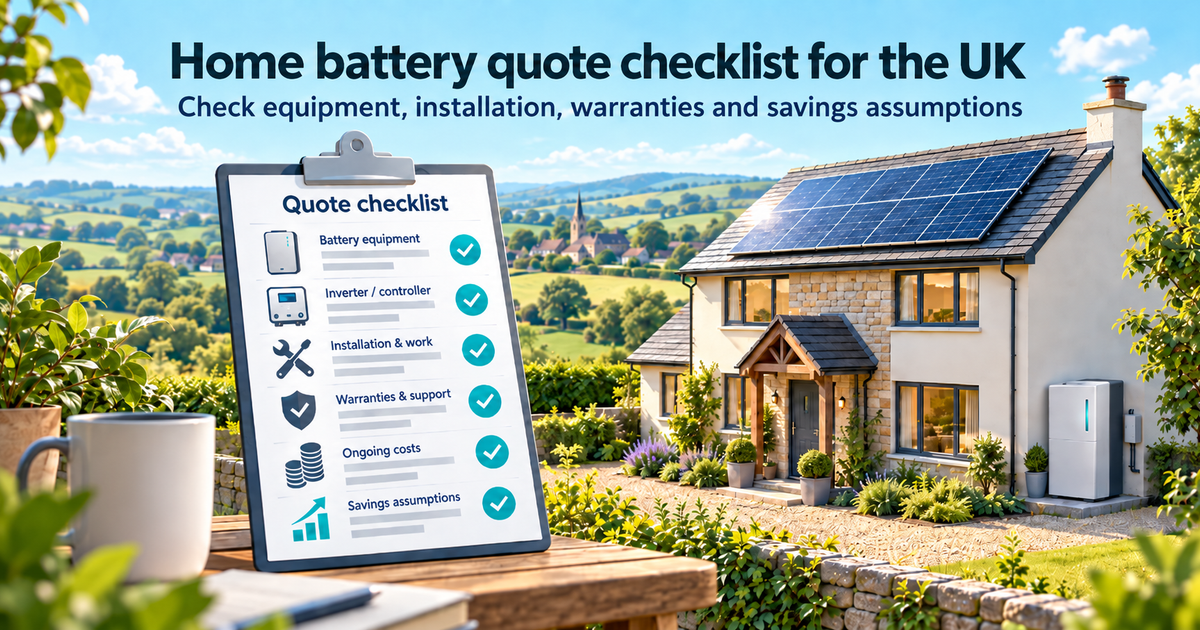
A useful home battery quote names the exact system, the work included and your total cost. It also separates warranties, ongoing charges and the assumptions behind any savings estimate. Use this checklist when adding a battery to solar panels you already own.
Based on published sources and a practical quote checklist, not a hands-on product test or an assessment of an individual installation.
This guide helps you turn an unclear offer into questions an installer can answer in writing. It is for a battery added to existing solar, compared with keeping that solar system without a battery. For the broader suitability and compatibility decision, read the existing-solar guide.
What should a home battery quote include?
Check what the written offer actually includes. If a line is unclear, ask for an updated quote before comparing totals.
- Exact equipment and configuration: Which battery, inverter or controller models and how many modules are quoted? Ask for stated usable capacity in kilowatt-hours (kWh, an amount of energy) and continuous charging and discharging power in kilowatts (kW, a rate). At which measurement boundary is capacity stated: AC or DC? Do not assume the figures are interchangeable. The sizing guide explains why capacity and power answer different questions.
- Fit with your existing solar: Which inverter, meters and controls stay, and which change? Give the installer the actual model details, if known, and ask them to assess compatibility at your property. A generic product description cannot confirm that fit.
- The complete installed amount: Does the price separate equipment, required extras, installation, commissioning and other essential work? Ask for the full amount you would pay and its tax treatment. Is it fixed, or dependent on a site survey or a named condition? For cost context, see the UK home battery cost guide.
- Site work and connection responsibilities: Who checks the proposed location, electrical work, any network operator process and site limitations? Who supplies the handover documents, and which related costs are included? Ask the installer to identify any work that falls outside their quote.
- Backup and optional extras: Is power during an outage included at all? If offered, ask what functions, extra equipment and work it needs. Keep its price separate from the base battery addition; a battery does not automatically supply your home during a power cut.
- Warranties and support: Ask separately for the manufacturer's product warranty, any capacity or performance warranty, and the installer's workmanship cover. Request the written terms, operating or energy-throughput limits, registration requirements and the contact responsible for claims. Who pays for labour or visits? A warranty period is not the calculator's assumed working life or a savings promise.
- Ongoing and later costs: Are subscriptions, monitoring or servicing fees required for the quoted functions? Separate mandatory payments from optional services and ask about known later costs. An unstated fee is not evidence that the cost is zero.
- Written terms and handover: Who issues the offer and who does the work? Check its validity period, payment schedule, how changes will be priced, the handover contents and the contact after installation. Ask for unclear terms in writing before deciding.
How to compare two battery quotes
Start with the same delivered scope, not the lower headline price. Against each important checklist item, note Included, Extra cost, Not stated or Not applicable, based on the offer's words. Confirm whether capacity, power, installation and aftercare describe like-for-like systems.
For example, in a fictional comparison, one quote names the required controller and commissioning while the other does not say whether either is included. Ask the second installer to clarify those items in writing. Silence does not make them free or establish which offer is better.
Questions to send your installer
Select and copy this text into your own email, adapting it to your property. Send it yourself to an installer you choose.
Hello,
I already have solar panels and am considering adding a home battery. My current inverter and other equipment are [models, if known]. Could you please confirm the exact battery configuration, its usable capacity and power, and what happens to my existing inverter and metering?
Please send an itemised quote showing the full installed amount I would pay, any required extras, commissioning and the tax treatment. If backup is available, please show its functions, equipment and price separately. Could you also identify any required subscriptions or later costs, provide the written warranty terms, and tell me who handles support and labour if a problem occurs?
If you include a use or savings estimate, please explain the source data and assumptions, including annual energy delivered to my home, system losses, avoided grid purchases and solar export income forgone. Please flag anything that depends on a site survey.
Thank you.
Battery Payback does not receive or forward your request.
Check the savings assumptions
A quoted price alone cannot prove annual savings. Keep the battery's usable capacity (kWh), its charge and discharge power (kW), and the energy it may actually deliver over a year (kWh/year) separate. Capacity multiplied by 365 does not establish annual use. Timing, solar surplus and later household demand matter.
In this calculator, annual energy is your first-year assumption for AC electricity delivered through the battery to home loads instead of electricity you would otherwise buy from the grid, in kWh/year. The corresponding charging energy is solar that would otherwise have been exported, measured on a comparable AC boundary. Whole-system efficiency includes the losses along that path; a manufacturer's cell or DC efficiency is not automatically the same figure. The calculator accounts for avoided import and forgone net export income on those boundaries, so do not count losses twice.
If an installer gives a savings forecast, ask what benefits and price assumptions it includes. Do not paste a figure containing grid charging, backup value, finance effects or grid-service income into this solar-shifting calculator as though it were annual delivered energy. Those benefits need a separate assessment.
An installer forecast is not required to explore your own clearly named Lower, Central and Higher use assumptions. Central is a scenario you choose, not the most likely outcome. The worth-it guide explains how to interpret the financial results and their limits.
Your next step
Quote still incomplete? Use the installer message above to request the missing details. A revised offer can make the comparison clearer.
Quote sufficiently itemised? Check your quote in the calculator. It opens the current calculator with no quote values transferred or prefilled. Choose GBP, enter the entire additional installed cost of adding the battery, and put extra annual costs in their separate field. Do not add the price you already paid for your solar system again.
Clarifying the offer, changing your stated assumptions or deciding against a battery are all reasonable next steps. A favourable scenario is not a purchase instruction.
Sources and checking date
External sources checked 27 September 2026. They provide general UK installation and quote-process context. This eight-point checklist, the email text and the fictional comparison are Battery Payback's editorial guidance, not an official checklist issued by either source.
- Energy Saving Trust, Battery storage — solar storage, professional installation, warranty questions and obtaining quotes.
- Energy Saving Trust, Installing renewable technology — general installer-quote, scope and handover questions; its heating-specific examples are not applied to batteries here.
The calculator's energy, cost and efficiency boundaries follow Battery Payback's own calculation contract, not an external installation guide.
For compatibility and the wider decision, read the guide to adding a battery to existing solar.