
UK HOME BATTERY GUIDE
How much does a home battery cost in the UK?
Adding a battery to existing solar? Start with the complete installed price, not just the battery unit. This guide explains what changes a UK quote, what to keep separate and how to check the cost against your own payback assumptions.
Based on published sources and illustrative calculations, not a hands-on product test.
What does a home battery cost?
Energy Saving Trust's battery storage guide gives a general reference of around £4,600 for a 5 kWh battery system. This is the source's reference, not Battery Payback's own price research, a UK average or a quote for your home. Its price passage does not specify everything included in a retrofit installation or the VAT treatment. The amount you would actually pay to add a battery to your existing solar needs an itemised installer quote.
That reference does not suggest that 5 kWh suits your household. Nor can it be scaled to price a larger system. The separate figures in the example below are entirely invented to show how quote totals work; neither set of figures is entered into the calculator for you.
What should the installed price include?
Ask the installer to name the exact battery configuration and distinguish its equipment price from the complete cost of adding it to your solar system. An itemised quote should show the battery, any required inverter or controller, and what remains in use from your existing system. It should identify necessary metering, controls and other parts, installation, commissioning and any mandatory extra work at your property. Ask which network-connection checks or work the installer expects and whether any related charge is included; this varies by installation.
Keep optional backup capability and other upgrades separate, with their own prices. Check the proposed scope before comparing totals: two headline prices may describe different hardware, work or functions. For the broader compatibility questions and the full quote checklist, use the existing-solar guide.
A battery unit sold on its own is not the installed addition. A new solar-plus-battery system is a different purchase again. If you already paid for your panels, do not add their old cost to this battery decision. If a supplier quotes new solar and battery together, request an itemised battery addition rather than subtracting a guessed panel price from the package.
Compare the total, not the headline
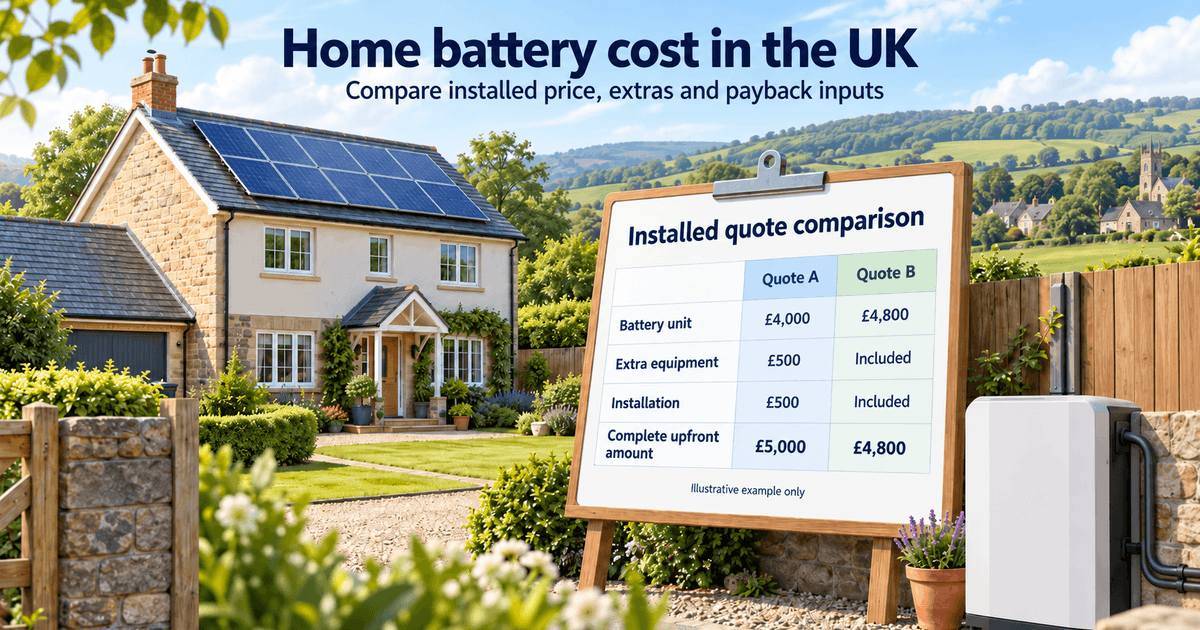
This is a wholly hypothetical comparison, not market pricing or actual offers. It assumes the same agreed system scope in both quotes and amounts on the same buyer-payable basis, including any applicable VAT.
| Cost item | Quote A | Quote B |
|---|---|---|
| Quoted starting amount | £4,000 | £4,800 |
| Required extra equipment not included above | £500 | Included |
| Installation and commissioning not included above | £500 | Included |
| Complete upfront amount | £5,000 | £4,800 |
For A, £4,000 + £500 + £500 = £5,000. B's “Included” items are already within its £4,800, so A's lower starting figure becomes a £200 higher upfront amount (£5,000 − £4,800). This compares only what is payable now. It does not establish that B is the better purchase: suitability, warranties, annual costs and use assumptions still need checking.
Keep VAT and ongoing costs clear
HMRC's VAT Notice 708/6 says qualifying installations of domestic electrical storage batteries, including retrofits to solar, may benefit from the temporary 0% VAT rate through 31 March 2027. An uninstalled sale of materials is treated differently and is standard-rated. Other work supplied alongside an installation can affect the treatment. Ask the installer to show the VAT basis of each relevant part and the total you will pay; do not assume every item qualifies.
Then identify costs that continue after installation, such as a required subscription or maintenance charge, and ask whether they are obligatory for the quoted functions. A particular product's fees cannot be inferred from a general battery price. Put genuine additional yearly costs in the calculator's separate annual-cost input. Finance charges, known later replacement work and end costs are outside its current model; if material, use a fuller assessment rather than silently folding them into its results.
Does a cheaper battery pay back sooner?
A lower complete upfront cost improves the calculator's modelled financial result when every other assumption is unchanged. Different configurations may deliver different amounts of energy later to the home, lose different amounts in charging and discharge, or incur different annual costs. Price alone therefore cannot establish which system pays back, or whether either does.
The relevant annual energy is electricity delivered from the battery to home loads in place of grid purchases, measured in kWh/year. Battery capacity in kWh is stored energy, while power in kW is a rate. Neither establishes annual delivery; multiplying capacity by 365 does not measure actual use. For different proposed configurations, the three-system comparison guide shows why exact scope and shared assumptions matter.
Stored solar also has an opportunity cost: some electricity sent to the battery might otherwise earn export income, while storage losses mean less reaches the home. Compare the avoidable import price with the export income forgone under your own agreement, then include additional annual costs once. Ofgem's Smart Export Guarantee supplier guidance describes tariff arrangements, while its scheme overview limits eligible installations to Great Britain. Do not apply SEG terms automatically to every UK export arrangement. See how the calculator works for its measurement boundary and limits.
Check your quote, then your assumptions
No itemised quote yet? Use the quote checklist to ask an installer what is included and what needs clarification. That guide also covers compatibility and usage questions in more detail.
Already have a quote? Check your quote in the calculator. Select GBP and enter the complete additional installed amount you would pay on a consistent tax basis, not the battery unit's starting price. Enter additional annual costs separately, then supply your own annual home-delivered energy, prices, efficiency, life and return assumptions. The link opens a blank calculator; it does not transfer or prefill any figures.
If the scope is unclear, ask for a revised quote. If your assumptions are uncertain, explore other stated scenarios. If the result remains unfavourable or required later costs lie outside the model, keeping your existing solar without a battery is also a valid outcome. Neither link requests a quote or sends your details to an installer.
Sources and checking date
External sources checked 26 September 2026. The published price reference and the invented quote comparison serve different purposes.
- Energy Saving Trust, Battery storage — general 5 kWh system price reference; no complete retrofit scope or VAT basis is stated in that price passage.
- HMRC, VAT Notice 708/6 — conditional battery-installation relief, temporary rate period and treatment of goods without installation.
- Ofgem, Smart Export Guarantee for electricity suppliers and scheme overview — supplier terms and Great Britain eligibility scope.
The Quote A and Quote B figures are Battery Payback's fictional arithmetic illustration, not external price observations or calculator defaults.
Start with the guide to adding a battery to existing solar for an itemised quote checklist.