
UK HOME BATTERY GUIDE
Adding a battery to existing solar in the UK
Adding a battery to an existing solar system can be possible, but the compatibility of your equipment, the complete additional installed cost and how you actually use stored solar decide whether it makes sense. Ask an installer to assess your system and compare a fully itemised quote with keeping your existing solar unchanged.
Based on published sources and illustrative calculations, not a hands-on product test.
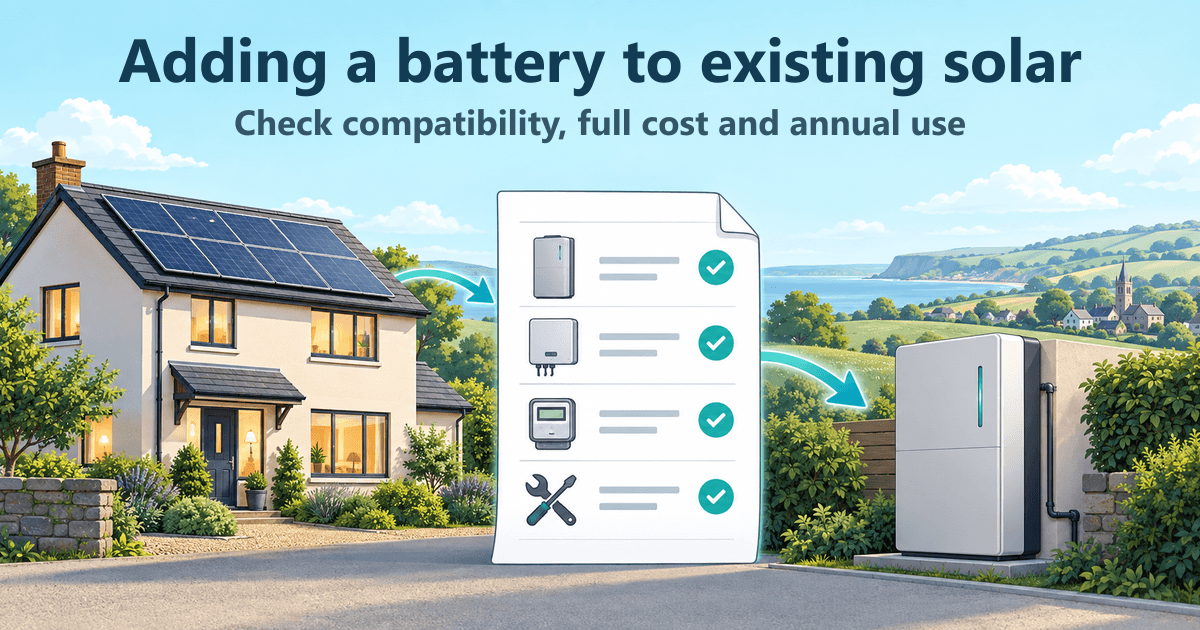
When this comparison fits
Use this guide if you already have solar panels and want to compare adding storage with keeping the same home and solar system without a battery. The calculator models the battery's extra cost and the solar energy it shifts to later home use. It does not count the existing solar system's savings again. If you are buying solar and storage together, expect grid charging or dynamic tariff optimisation, need to value backup power, or want to include revenue from reserve or grid services, you need a separate analysis. The current calculator does not model reserve or grid-service revenue, or those other benefits; leaving them out here does not mean they cannot matter in some circumstances.
Energy Saving Trust explains that batteries can store surplus solar for later use and should be connected to the existing system by a professional. This guide does not assess installation or electrical safety for an individual home.
Check the existing system first
Give the installer the make and model of your panels, existing inverter, export meter and any monitoring equipment. Ask whether the existing inverter stays, needs replacement or needs an additional battery inverter or controller; whether the proposed battery can operate with that exact arrangement; and where the proposed energy measurements are taken. Ask how the system will behave when solar generation, household demand and battery charge differ. A quote should explain any gateway or backup arrangement separately. The Powerwall 3, SigenStor and SMILE-G3 guides illustrate why configuration matters; they are document-based product guides, not suitability verdicts.
Read the whole installed cost
Ask for the additional cost of the battery installation, itemised into the battery and usable capacity, required inverter or controller, measurement equipment, any gateway or backup hardware, installation, commissioning and other mandatory work. Separate optional backup features or upgrades from the base system. Clarify recurring monitoring, subscription, servicing and other additional annual costs, plus any known mandatory later replacement or end cost. If significant later costs are known but cannot fit the current model, use a fuller comparison.
The calculator's upfront input is the full incremental amount you pay for adding the battery, not the price of the existing solar system. A quote is evidence of a price for a specified configuration, not evidence of annual savings.
Turn capacity into a use assumption
Battery capacity (kWh) describes stored energy at a stated measurement boundary. Power (kW) describes a rate of charge or discharge. Neither is the first-year annual AC energy (kWh/year) delivered from the battery to your home's loads that would otherwise have been bought from the grid. Do not multiply capacity by 365 to estimate that yearly value. Ask for a transparent use estimate tied to your solar exports and electricity demand, or enter your own clearly labelled what-if values. An installer forecast is useful context, not a prerequisite for exploring scenarios.
Check the boundary of any external estimate: is it DC cell throughput, AC battery output, or AC energy actually delivered to the home in place of grid purchases? The calculator needs the last of these. Its whole-system efficiency compares that home-delivered AC energy with the AC solar that would otherwise have been exported and includes the relevant conversion and auxiliary losses. The optional annual surplus and import values are upper-bound checks, not forecasts; annual totals cannot establish whether charging and discharge are possible at the right times or powers.
Enter three ordered first-year energy values for Lower, Central and Higher. They may be equal. Central is not a forecast or the most likely outcome. See how the calculations work for the model's limits.
Value the shifted solar, including what you give up
The battery may avoid a variable electricity purchase, but diverting solar that would otherwise be exported may forgo export income and incur storage losses. Enter only the avoidable purchase cost per kWh, excluding fixed bill charges that stay the same. Enter the net export income actually forgone on the comparable AC solar; check your own agreement, as export terms differ. Ofgem explains that Smart Export Guarantee suppliers in Great Britain can set tariff rates, contract lengths and other terms. Do not treat otherwise-exported energy as automatically free or apply the same export arrangement to every UK household. Include additional annual running costs once, without double-counting losses already covered by whole-system efficiency.
Two outcomes from the same artificial quote
Two hypothetical cases, not product forecasts, UK averages or available tariffs. Both use exactly the same artificial 4000.00 GBP additional installed battery quote. This is not a typical UK installation price. Other shared assumptions: first-year AC energy delivered from the battery to the home 1800.0 kWh/year; whole-system AC efficiency 90%; avoided purchase price 0.3000 GBP/kWh; additional running cost 50.00 GBP/year; delivered-energy decline 1% a year; analysis period and assumed life 15 and 15 years; real annual return target 3%. Warranty, capacity and annual import/export checks are unknown.
Only the net export income given up changes: 0.0500 GBP/kWh or 0.3000 GBP/kWh on otherwise-exported AC solar. No tax benefit or currency conversion is included.
| Case | Export income given up | First-year net saving | NPV at 3% | Sustained recovery | Interpolated payback estimate |
|---|---|---|---|---|---|
| Lower export income in this example | 0.0500 GBP/kWh | 390.00 GBP | 330.68 GBP | Year 11 | 10.84 years |
| Higher export income in this example | 0.3000 GBP/kWh | −110.00 GBP | −5268.84 GBP | Not recovered within the analysis period | Not applicable — no sustained recovery |
Lower export income in this example: 1800.0 kWh of first-year home delivery requires 2000.0 kWh of otherwise-exported AC solar. Avoided purchases are 540.00 GBP; forgone export income is 100.00 GBP; additional running cost is 50.00 GBP. First-year net saving is 390.00 GBP.
Higher export income in this example: 1800.0 kWh of first-year home delivery requires 2000.0 kWh of otherwise-exported AC solar. Avoided purchases are 540.00 GBP; forgone export income is 600.00 GBP; additional running cost is 50.00 GBP. First-year net saving is −110.00 GBP.
With lower export income, NPV is positive at 330.68 GBP, the investment is recovered within the 15-year analysis period, and this case meets the selected 3% real return target under these assumptions. With higher export income, first-year net saving is negative at −110.00 GBP, NPV is negative at −5268.84 GBP, and the investment is not recovered within that period. Only the forgone export income changes between these artificial cases. Neither outcome forecasts a real household.
These are model calculations, not household or product predictions. The upfront amount, annual use, prices and life are illustrative assumptions, and physical timing and power remain unchecked. Your own tariff and quote can change the result substantially.
Quote checklist
Use this list to request comparable, itemised offers. Asking for a quote does not commit you to buying a battery.
- Existing equipment: identify your panels, inverter and metering. Ask what stays, what changes and why the proposed configuration is compatible.
- Complete upfront amount: separate the battery, inverter or controller, metering, gateway or backup parts, installation, commissioning and every mandatory extra task. Identify optional items and the buyer's total cost on a consistent basis.
- Ongoing obligations: list monitoring or subscription fees, servicing, known replacement work, warranty conditions and any required later costs separately.
- Annual use estimate: ask for first-year AC energy delivered from the battery to home loads in place of grid purchases, the solar-export and demand assumptions behind it, and its measurement boundary. Request the whole-system AC efficiency on the same boundary.
- Tariff and export: compare your avoidable import unit price with the net income you would give up on diverted exports under your own agreement. Separate fixed charges.
- Scope and limits: ask what backup functions, power limits and system controls are included, and which proposed benefits need a different model.
What to do next
Compare the itemised quote and use assumptions in the calculator, then review the results, missing checks and calculation method. A favourable scenario is not an instruction to buy. If the estimate is unfavourable or the offer leaves major costs or compatibility unanswered, seek clarification, revise your assumptions or keep the existing solar system without a battery. See our editorial and commercial policy for how these guides are prepared.
Sources and checking date
External sources checked 24 September 2026. These sources explain general battery use and export arrangements; the example figures are our own hypothetical model inputs.
- Energy Saving Trust, Battery storage — storage of surplus solar, installation and suitability context.
- Ofgem, Smart Export Guarantee for electricity suppliers — supplier terms and Great Britain scope.
Explore the battery guide directory for specific configurations.