
UK HOME BATTERY GUIDE
Sigenergy SigenStor: how configuration and usage affect payback
Exporting solar by day and buying electricity later? SigenStor could help you use more of your own generation. Its payback is different in every home: the complete installed cost and the solar you actually use later matter more than a battery-module count.
Based on manufacturer documents and illustrative calculations, not a hands-on product test.
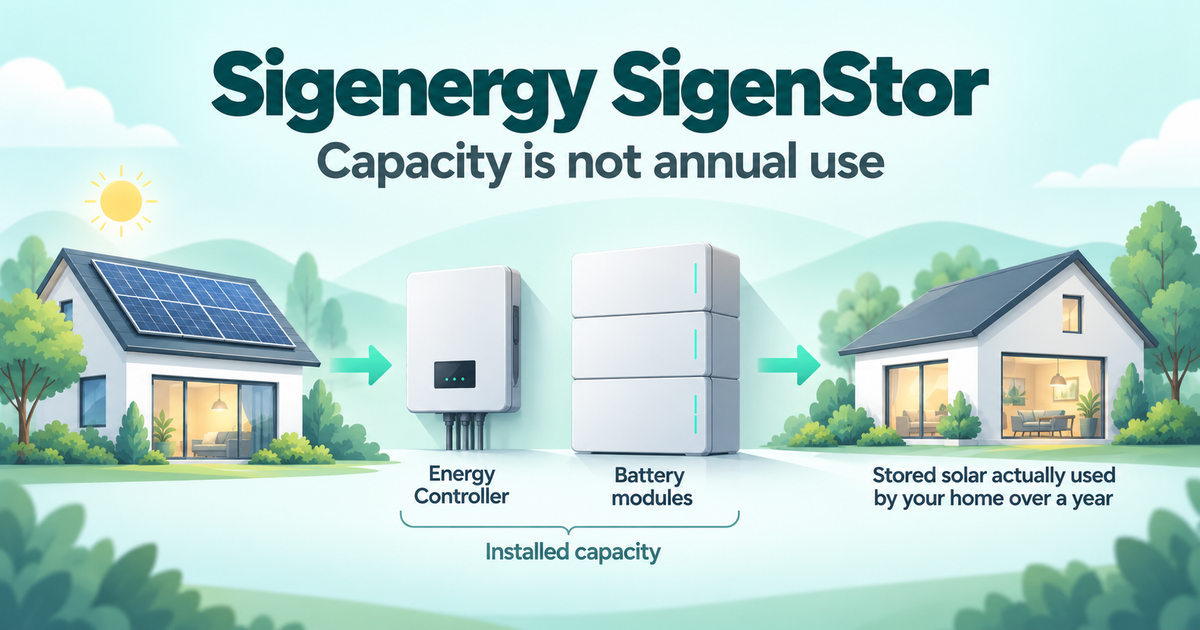
Which SigenStor stack is on the quote?
The SigenStor product page describes a modular Energy Controller, battery packs and optional EV DC charging module. This guide concerns the original single-phase SigenStor EC with BAT 5.0/8.0 modules, not Neo or SigenStack. Optional equipment is not necessarily included.
The SigenStor-5S manual’s model examples distinguish a 5S-5 with EC 5.0 SP and one BAT 5.0 from a 5S-8 with the same controller family and one BAT 8.0. The controller sheet, p. 1 lists 3.0, 3.6, 4.0, 4.6, 5.0 and 6.0 SP variants with different nominal AC output. Separately, the BAT sheet, p. 2 gives 5.38/8.06 kWh total, 5.2/7.8 kWh usable at its beginning-of-life test, and 2.5/4 kW maximum module charge/discharge power. Ask for exact models, module count and the limiting system power; a suffix or capacity is not an annual-savings estimate.
Will the controller replace or sit beside your PV inverter? Ask for a battery-addition quote against leaving the present solar system unchanged: controller, BAT modules, base, connectors, meters, any gateway or EV hardware, installation and commissioning. Keep recurring charges or idle losses separate.
How much stored solar will you actually use?
More storage may hold more solar in one charging window, but it cannot create surplus or later demand. The calculator needs first-year AC energy delivered from the battery to your home, not module DC capacity or controller power. The BAT test conditions, p. 2 do not establish feasible annual cycles; capacity × 365 is not a forecast.
Use export records and later household demand to support a separate estimate for each quoted stack. Known annual export or import limits, if exceeded, cause the calculator to reject a scenario—not trim its energy automatically. Passing those totals cannot prove timing, and a larger battery may leave annual savings unchanged.
The product page also discusses smart management and EV DC charging. Grid charging, dynamic tariffs, V2X or grid-service revenue need separate current evidence of equipment, compatibility and availability. None belongs in this solar-self-consumption example.
Sigenergy’s 27 May 2025 Europe warranty, pp. 1–3 distinguishes controller and BAT terms, battery retention, throughput and connectivity conditions. Neither its listing nor the document explicitly confirms UK applicability. Obtain terms for the actual offered system; warranty duration is not operating life, and retention does not give an annual decline rate.
What varying annual delivery changes
Only first-year AC energy delivered to the home changes below. No row represents a particular BAT count or typical household use.
Hypothetical example. These are not product prices, available tariffs, UK averages or performance forecasts. Money is in today’s purchasing power.
Only energy delivered from the battery to your home in year one changes. Other assumptions:
- Additional installed battery cost: 6000 GBP
- Whole-system AC efficiency: 90%
- Avoided electricity purchase price: 0.3000 GBP/kWh
- Export payment you give up: 0.0500 GBP/kWh
- Extra running cost: 50 GBP/year
- Annual fall in delivered energy: 1%
- Analysis period and assumed battery life: 15 and 15 years
- Real return target: 3%
Efficiency is AC energy delivered from storage to your home divided by the AC solar that would otherwise be exported, including relevant losses. Life, decline and efficiency are artificial assumptions, not warranty terms. Warranty, battery capacity and annual import/export limits are unknown; physical use, timing and power are unverified. No tax benefit or currency conversion is included.
Rows span this example’s return threshold; they are not probabilities or best/base/worst predictions.
| Energy delivered to your home in year one (kWh/year) | First-year net saving | NPV at 3% | Interpolated payback estimate |
|---|---|---|---|
| 1800 | 390.00 GBP | −1669.32 GBP | Not applicable — no sustained recovery |
| 2400 | 536.67 GBP | −26.80 GBP | 11.86 years |
| 3000 | 683.33 GBP | 1615.73 GBP | 9.17 years |
What would make the numbers work?
At 2400 kWh/year, cash outlay is recovered after 11.86 years, but NPV is −26.80 GBP: the 3% real return target is missed. At 3000 kWh/year it is met under these assumptions. Ask how measured export and later demand support either figure before paying for more modules.
The calculator values otherwise-exported AC solar stored for later AC home use. It does not assess a new solar installation, grid charging, hourly tariffs, VPP/reserve/V2G income, backup value, finance, automatic grants or tax benefits, battery replacement, residual value or end costs. It cannot verify annual-use, timing, power or state-of-charge feasibility.
Questions to ask your installer
- Which exact EC and BAT models, module count, base and meters are included? Which datasheets and applicable warranty revision cover them?
- How will the stack connect to your existing inverter? Are gateway, backup or EV parts included and enabled?
- What are all compulsory equipment, labour and commissioning costs, and any continuing costs or idle losses?
- Which measured exports, imports and later demand support the annual AC delivery estimate? What usable capacity and power limit apply?
Request an itemised stack and its extra installed cost. Then check a supported annual-use estimate against your own data.
Check your quote in the calculator
Select GBP and enter your own cost, AC delivery, prices and time assumptions. It compares solar self-consumption, not grid charging or grid-service income, and does not verify timing or power. It does not select a SigenStor stack.
Two quick checks
Does BAT 8.0 deliver eight kWh to the home every day?
No. The module sheet gives 7.8 kWh usable under test conditions. Battery energy, delivered AC energy and annual use are different quantities.
Does the EV module belong in this payback estimate?
No. First confirm it is quoted and compatible; assess EV or grid-service value separately.
Sources and checking date
Manufacturer material checked 22 September 2026. The current Europe-listed warranty's UK applicability remains unverified; it is not presented as the UK warranty.
- Sigenergy, SigenStor product overview.
- Sigenergy, SigenStor-5S user manual, model designation.
- Sigenergy, Sigen Energy Controller datasheet, version 20260330, page 1 single-phase table.
- Sigenergy, Sigen Battery 5.0/8.0 datasheet, 30 April 2025 download listing, page 2.
- Sigenergy, Factory Limited Warranty for SigenStor (For Europe), 27 May 2025, pages 1–3.
For a different kind of configuration check—an AC-coupled versus hybrid inverter—see the AlphaESS SMILE-G3 model guide.
Explore the battery guide directory for the other product configurations.