
UK HOME BATTERY GUIDE
AlphaESS SMILE-G3: what to check before estimating payback
Adding storage to existing solar? A SMILE-G3 quote may offer an S5 hybrid or B5 AC-coupled route, and your current inverter matters to that choice. Neither has one payback period for every home: compare the extra installed cost with the value of solar used later rather than exported.
Based on manufacturer documents and illustrative calculations, not a hands-on product test.
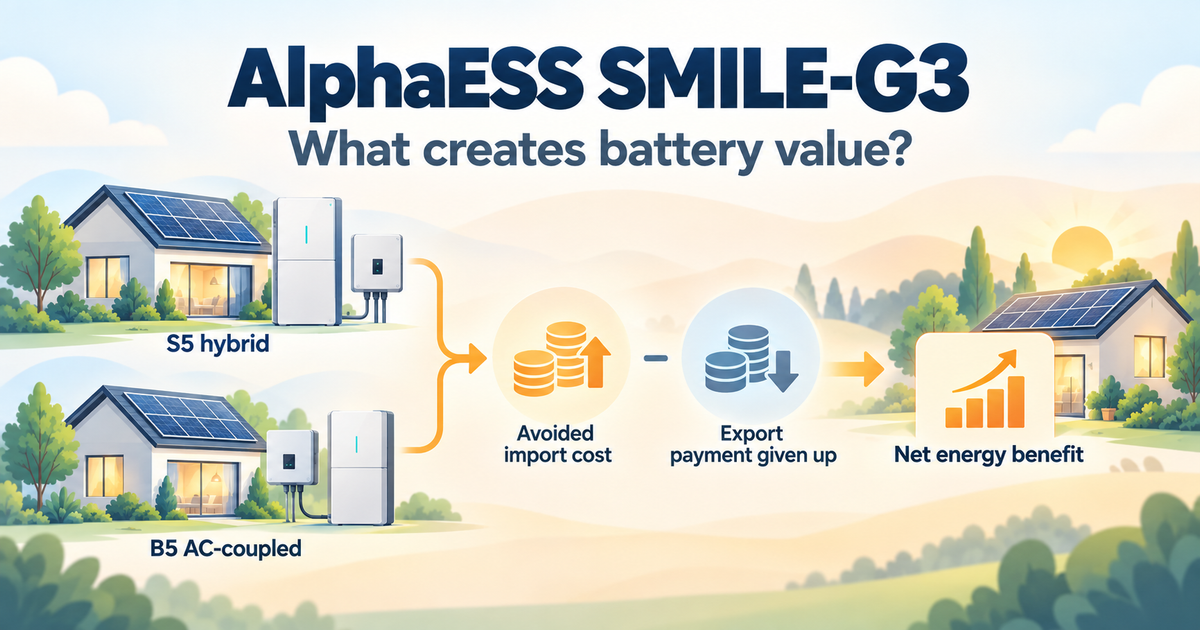
Which G3 design fits your existing solar?
The S3.6/S5/B5 datasheet, p. 2 names SMILE-G3-S5-INV as a 5 kW hybrid inverter with PV input and SMILE-G3-B5-INV as a 5 kW AC-coupled variant without that PV input specification. It also lists a 3.68 kW S3.6 hybrid. The S5/B5 product page makes the same hybrid/AC distinction. B5 may suit a design retaining an existing PV inverter, but the label alone does not prove compatibility or cost; ask which inverter stays.
The module table separately names SMILE-G3-BAT-3.8S (3.8 nominal/3.6 usable kWh), BAT-8.2P (8.2/7.8) and BAT-10.1P (10.1/9.6) under its conditions. It gives 95% depth of discharge and different module arrangements. The -INV name identifies the inverter; BAT identifies storage. Usable DC-side battery energy is neither annual energy nor a promise of the same AC kWh at your sockets.
Ask for each model and count, connections, meters, backup parts, inverter changes, installation and commissioning. If panels and battery are bundled, get a comparable battery-addition cost rather than subtracting a guessed panel price. List recurring costs separately.
Which energy and price figures matter?
Depth of discharge describes the permitted share of nominal battery capacity under test conditions. The V08 sheet’s 97.3% maximum inverter efficiency measures something else again. Neither it nor the 95% depth of discharge is the whole AC path from otherwise-exportable solar through storage to later home use. Ask for an efficiency estimate across that path, including relevant losses.
First-year AC energy delivered to your home depends on solar surplus and later demand. A 9.6 kWh usable module × 365 does not forecast annual delivery; module size and inverter kW cannot establish timing or power feasibility.
Storing exportable solar also gives up its net export payment. Battery losses mean more AC solar is diverted than later reaches the home. Compare genuinely avoided import costs with that lost income and extra running costs, not purchase price alone.
The older global V08 datasheet states five years for product and ten for battery performance. The separate December 2024 UK G3 warranty, pp. 1–4 and 8 names S5, B5 and BAT models, with a ten-year product term and a distinct 120-month performance term subject to application, throughput, DC-side capacity, connectivity and installer conditions. Request current terms for the quoted models; neither document sets annual decline or expected life.
How avoided purchase cost changes the example
Only the genuinely avoided purchase price changes here. Fixed bill charges are not avoided. These artificial values are not available tariffs or advice to choose a dearer contract; lost export income remains in every row.
Hypothetical example. These are not product prices, available tariffs, UK averages or performance forecasts. Money is in today’s purchasing power.
Only avoided electricity purchase price changes. Other assumptions:
- Additional installed battery cost: 6000 GBP
- AC energy delivered to your home in year one: 1800 kWh/year
- Whole-system AC efficiency: 90%
- Export payment you give up: 0.0500 GBP/kWh
- Extra running cost: 50 GBP/year
- Annual fall in delivered energy: 1%
- Analysis period and assumed battery life: 15 and 15 years
- Real return target: 3%
Efficiency is AC energy delivered from storage to your home divided by the AC solar that would otherwise be exported, including relevant losses. Life, decline and efficiency are artificial assumptions, not warranty terms. Warranty, battery capacity and annual import/export limits are unknown; physical use, timing and power are unverified. No tax benefit or currency conversion is included.
Rows span this example’s return threshold; they are not probabilities or best/base/worst predictions.
| Avoided electricity purchase price (GBP/kWh) | First-year net saving | NPV at 3% | Interpolated payback estimate |
|---|---|---|---|
| 0.3000 | 390.00 GBP | −1669.32 GBP | Not applicable — no sustained recovery |
| 0.3800 | 534.00 GBP | −56.66 GBP | 11.93 years |
| 0.4600 | 678.00 GBP | 1556.00 GBP | 9.25 years |
What would make the numbers work?
At 0.3800 GBP/kWh, the example recovers its cash outlay after 11.93 years, yet −56.66 GBP NPV misses the 3% real return target. Check your actual avoidable purchase cost, net export payment, annual AC use and extra installed cost. The model keeps real annual prices constant; it does not optimise hourly tariffs.
Separate export stress: return to the base case—avoided purchase price 0.3000 GBP/kWh, extra cost 6000 GBP and year-one AC home delivery 1800 kWh/year. Change only the export payment given up to 0.3000 GBP/kWh. First-year net saving becomes −110.00 GBP, NPV −7268.84 GBP, and payback Not applicable — no sustained recovery over 15 years. This artificial stress is not an AlphaESS forecast or UK tariff.
The calculator compares adding storage with keeping the same solar system. It does not assess a new solar installation, grid charging, hourly tariffs, VPP/reserve/V2G income, backup value, finance, automatic grants or tax benefits, battery replacement, residual value or end costs. It cannot verify annual use or timing, power and state-of-charge feasibility.
Questions to ask your installer
- Is the inverter S5 hybrid, B5 AC-coupled or another G3 model? Which BAT identifiers and counts are included, and what happens to your existing inverter?
- What nominal and usable capacities, AC path and operating limits apply to these parts?
- What compulsory equipment, metering, installation and commissioning costs form the battery addition? Are there ongoing charges?
- Which current UK product and performance terms apply to each model? What supports annual AC delivery and export assumptions?
Get an itemised quote first. Then test its real extra cost and your supported energy and price assumptions.
Check your quote in the calculator
Select GBP and enter your own cost, AC delivery and prices. This compares solar self-consumption, not grid charging or backup value, and cannot verify timing or power. A G3 model name fills in nothing automatically.
Two quick checks
Is B5 a battery module?
No. B5-INV names the AC-coupled inverter variant; storage modules carry BAT identifiers.
Can I use 97.3% as battery round-trip efficiency?
No. It is a maximum inverter figure, not the whole solar-to-battery-to-home AC path.
Sources and checking date
Manufacturer documents checked 22 September 2026. The datasheet is V08.01062023; the December 2024 UK warranty addresses an identified subset of G3 models. Confirm the current quote-specific revision.
If your quote centres on an integrated solar inverter and optional storage expansion instead, see the Powerwall 3 incremental-cost guide.
Explore the battery guide directory for the other product configurations.