
UK HOME BATTERY GUIDE
Tesla Powerwall 3: what determines payback in a UK home?
Already exporting solar by day and buying electricity later? Powerwall 3 could shift some of that energy into your evening use. There is no payback period for every home: the installed battery addition, your inverter plan and the solar you can actually use later all matter.
Based on manufacturer documents and illustrative calculations, not a hands-on product test.
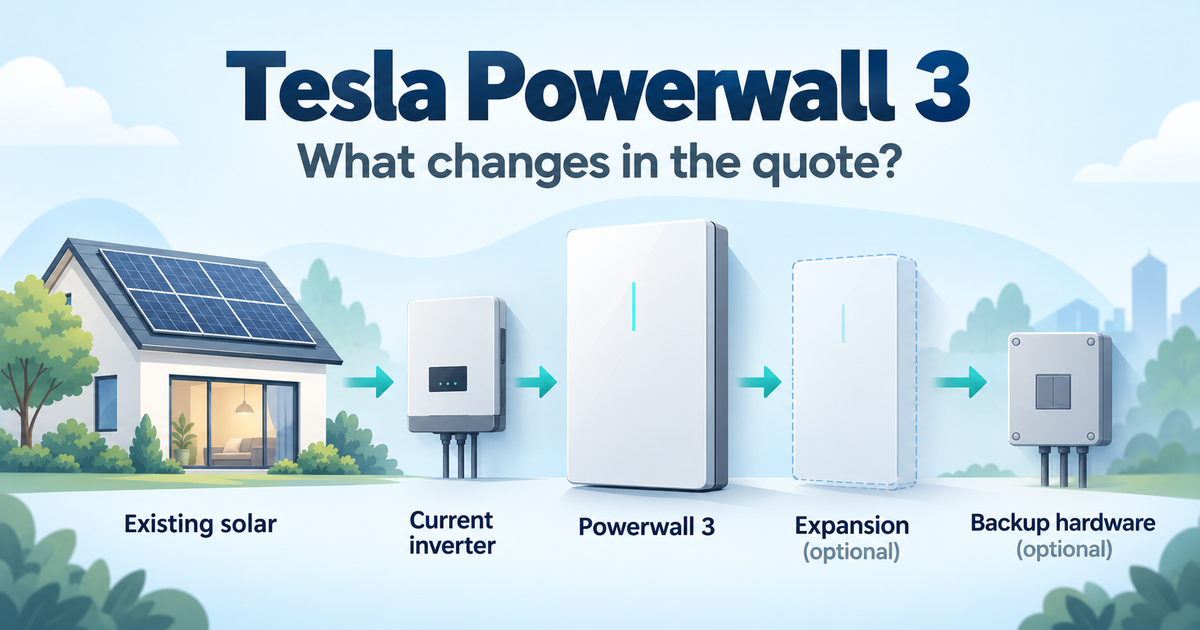
What happens to your existing inverter?
The 2026 UK datasheet, pp. 1–2 covers single-phase Powerwall 3 model 1707000-xx-y. It gives 13.5 kWh usable AC battery energy at specified beginning-of-life conditions and selectable nominal AC output from 3.68 to 11.04 kW at 230 V. Those are energy and power figures for this UK document, not annual energy your home will use or universal settings.
Powerwall 3 has integrated PV inputs. The UK connection diagrams, pp. 3 and 7–8 show existing AC-coupled solar with its own inverter as well as DC-connected arrangements, with different metering. Ask whether your inverter stays, is replaced or is reconfigured. A combined solar-and-battery quote needs a comparable breakdown of the battery addition; do not subtract a guessed panel price.
Include the unit, metering and connection parts, inverter or board changes, installation, commissioning and other compulsory upfront work. Keep recurring charges separate. This complete extra cost—not the price of a new solar system—is the calculator input.
Expansion, backup and losses: what is included?
Tesla’s UK datasheet, pp. 2, 4 and 7 identifies Expansion model 1807000-xx-y as 13.5 kWh of additional storage connected to Powerwall 3, not another complete unit with its own power electronics. Ask which option is quoted and what AC output and grid-connection limits apply to that combination.
Backup diagrams, pp. 5–8 require Backup Gateway 2 for backup and distinguish whole-home from partial-home circuits. Confirm the Gateway, circuits and price; a non-backup design need not include it. Outage protection may matter to you, but this calculator gives it no cash value.
The UK datasheet, p. 2 lists 89% for solar through the battery to home/grid and 97.5% for direct solar to home/grid under different tests. Neither figure can be used directly as the calculator’s whole-system AC efficiency. Here, efficiency means AC energy delivered from storage to your home divided by the AC solar that would otherwise be exported. Ask for an estimate across that actual path, with idle costs counted once.
The European-region warranty, rev. 1.16 includes the UK and names Powerwall 3 and Expansion part-number patterns. Its ten-year defect term, capacity retention, application-dependent throughput and connectivity conditions are distinct. Confirm the supplied parts and revision; placeholder suffix letters alone do not prove different coverage, and warranty terms do not set operating life or annual decline.
What a change in additional installed cost does
Only the extra installed cost changes below. These are not Powerwall prices or a UK price range.
Hypothetical example. These are not product prices, available tariffs, UK averages or performance forecasts. Money is in today’s purchasing power.
Only additional installed battery cost changes. Other assumptions:
- AC energy delivered to your home in year one: 1800 kWh/year
- Whole-system AC efficiency: 90%
- Avoided electricity purchase price: 0.3000 GBP/kWh
- Export payment you give up: 0.0500 GBP/kWh
- Extra running cost: 50 GBP/year
- Annual fall in delivered energy: 1%
- Analysis period and assumed battery life: 15 and 15 years
- Real return target: 3%
Efficiency is AC energy delivered from storage to your home divided by the AC solar that would otherwise be exported, including relevant losses. Life, decline and efficiency are artificial assumptions, not warranty terms. Warranty, battery capacity and annual import/export limits are unknown; physical use, timing and power are unverified. No tax benefit or currency conversion is included.
Rows span this example’s return threshold; they are not probabilities or best/base/worst predictions.
| Additional installed battery cost (GBP) | First-year net saving | NPV at 3% | Interpolated payback estimate |
|---|---|---|---|
| 3500 | 390.00 GBP | 830.68 GBP | 9.41 years |
| 4300 | 390.00 GBP | 30.68 GBP | 11.71 years |
| 6000 | 390.00 GBP | −1669.32 GBP | Not applicable — no sustained recovery |
What would make the numbers work?
Under these inputs, the engine puts the maximum upfront cost meeting the 3% real return target at 4330.68 GBP. That is an example-specific calculation, not a Powerwall price or obtainable quote. The middle row just clears the NPV threshold; the highest-cost row does not recover within 15 years. Interpolated cash-flow payback is undiscounted, unlike NPV.
This calculator compares adding a battery with keeping the same solar system. It does not assess a new solar installation, grid charging, hourly tariffs, VPP/reserve/V2G income, backup value, finance, automatic grants or tax benefits, battery replacement, residual value or end costs. It cannot verify annual use or the timing, power and state of charge needed to deliver it.
Questions to ask your installer
- Which Powerwall 3 and Expansion part numbers, output setting and inverter plan are proposed? Does the current PV inverter stay?
- Which Gateway, meters, circuits and other backup parts are included?
- What are all compulsory equipment, installation and commissioning costs compared with keeping the existing solar system? What extra annual costs follow?
- What supports the estimate of otherwise-exported solar used later at home, the AC efficiency and each component’s current UK warranty?
Ask for that itemised addition before comparing prices. With a quote, use its real extra cost and your supported usage assumptions.
Check your quote in the calculator
Select GBP and enter your own cost, AC energy, prices and time assumptions. This is an existing-solar self-consumption calculation, not a backup valuation or a check of charging times and power. The product name supplies no inputs.
Two useful distinctions
Does 13.5 kWh mean 13.5 kWh every day?
No. Usable capacity is measured under test conditions. Annual delivery needs both solar surplus and later demand; capacity × 365 is not a usage forecast.
Is Expansion another inverter?
No. It adds storage to Powerwall 3. Confirm the quoted configuration’s power limit separately.
Sources and checking date
Manufacturer documents checked 22 September 2026. Specifications concern the identified UK datasheet, not every global configuration. These links are evidence, not endorsements.
For a modular alternative where the controller and each battery module need separate identification, read the SigenStor configuration guide.
Explore the battery guide directory for the other product configurations.